
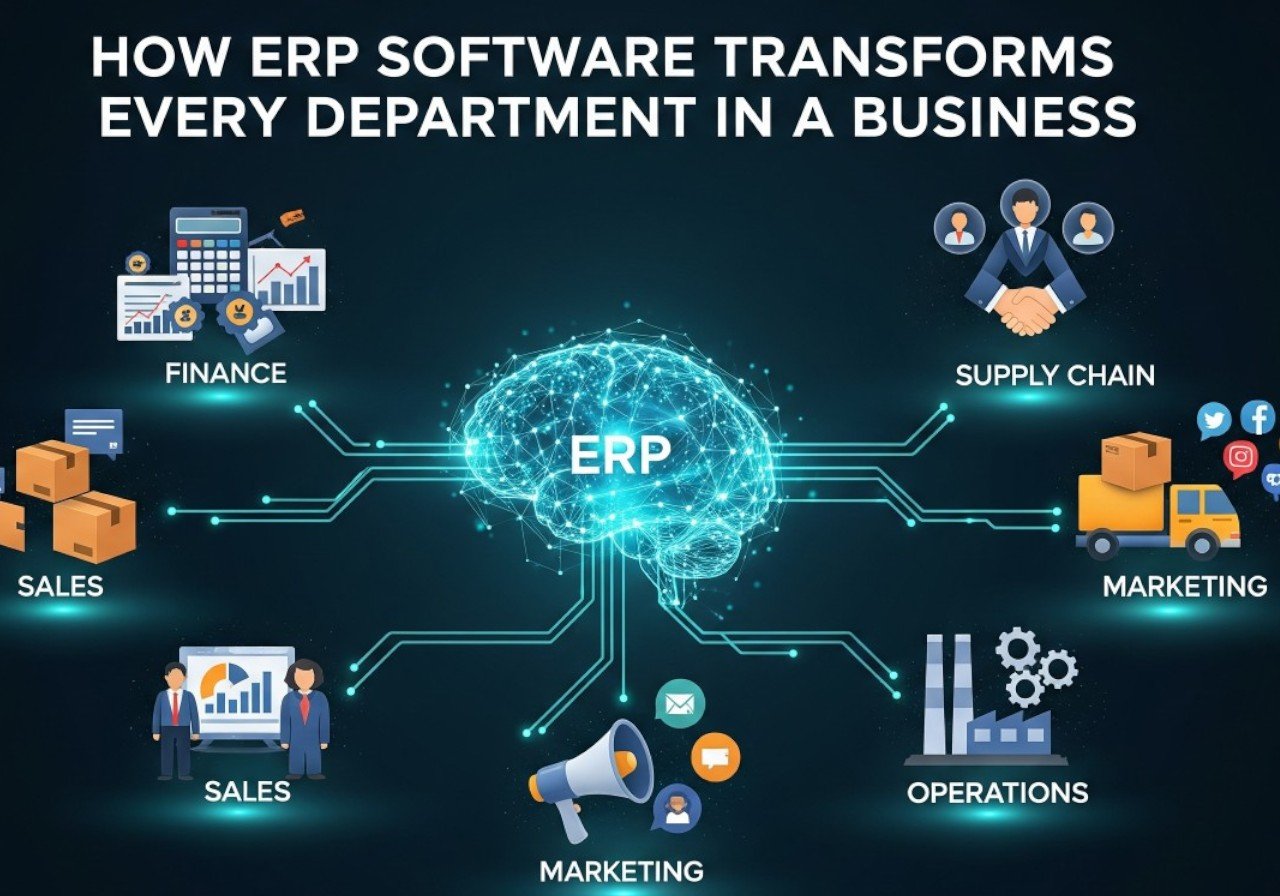
Every department – from finance to sales – plays a vital role. But without proper coordination, the music turns into noise. This is where ERP (Enterprise Resource Planning) steps in, ensuring all departments work in harmony.
Instead of each team using separate tools, ERP unifies them under one system. Let’s explore how ERP helps individual departments become more efficient, accurate, and growth-focused.
1. Finance & Accounting
Finance is the backbone of any business, and ERP makes it stronger.
- Automates invoices, payroll, and expense tracking.
- Reduces errors in tax and compliance reporting.
- Helps CFOs make faster, data-driven financial decisions.
👉 Result: Transparent, accurate, and stress-free financial management.
2. Human Resources (HR)
Managing people is as important as managing money. ERP transforms HR processes:
- Tracks employee attendance, leave, and payroll automatically.
- Simplifies recruitment, onboarding, and training.
- Stores all employee records in one secure database.
- Provides insights on workforce performance and productivity.
👉 Result: Engaged employees and simplified HR operations.
3. Sales & Customer Relationship
Customers are at the heart of every business. ERP ensures sales teams stay on top.
- Keeps a 360° view of customer history, preferences, and interactions.
- Automates lead tracking, quotations, and order processing.
- Integrates CRM features to improve follow-ups and customer support.
- Ensures timely deliveries with accurate stock and logistics data.
👉 Result: Happy customers, more sales, and stronger relationships.
4. Inventory & Supply Chain
ERP gives businesses full control over their stock and supply chain.
- Tracks raw materials, finished goods, and warehouses in real-time.
- Alerts when stock is low or overstocked.
- Helps forecast demand and optimize purchasing.
- Improves supplier management and reduces waste.
👉 Result: Optimized inventory and efficient supply chain.
5. Production & Manufacturing
For manufacturers, efficiency equals profit. ERP enhances production processes:
- Plans and schedules production based on demand.
- Tracks resources, machines, and manpower usage.
- Monitors product quality and ensures compliance.
- Reduces downtime by predicting maintenance needs.
👉 Result: Faster production, reduced costs, and improved product quality.
6. Marketing Department
ERP doesn’t just manage internal tasks – it also empowers marketing.
- Provides customer insights to create targeted campaigns.
- Tracks ROI of marketing activities.
- Helps analyze sales trends for better strategy planning.
- Integrates with email/SMS campaigns for direct customer engagement.
👉 Result: Smarter campaigns with higher conversion rates.
7. Top Management (CEOs & Leaders)
ERP provides a holistic view for strategic decision-making.
- Provides real-time dashboards covering every department.
- Helps in setting strategic goals and measuring KPIs.
- Offers predictive analytics for better decision-making.
- Ensures all departments align with business objectives.
👉 Result: Confident leadership and future-ready strategies.
Why Department-Wise ERP Benefits Matter
Without ERP, businesses face:
- Data duplication
- Miscommunication
- Delayed decision-making
ERP removes these barriers by creating one centralized system. Departments share information instantly, work more efficiently, and achieve common goals together.
Conclusion
From finance to HR, sales to production, every department benefits when processes are streamlined, data is unified, and insights are available in real time.
By adopting ERP, businesses not only cut costs and errors but also create a foundation for long-term growth and innovation.
Final Thought: A company that connects its departments with ERP is like an orchestra in perfect sync – producing music that customers, employees, and leaders all enjoy.