
Introduction
In today’s fast-paced business environment, managing operations manually or through multiple disconnected systems can slow growth and create errors. ERP software (Enterprise Resource Planning) solves this by uniting all key business functions under one platform. Unlike outdated tools, modern ERP systems offer automation, real-time insights, and seamless collaboration, making them a must-have for 2025.
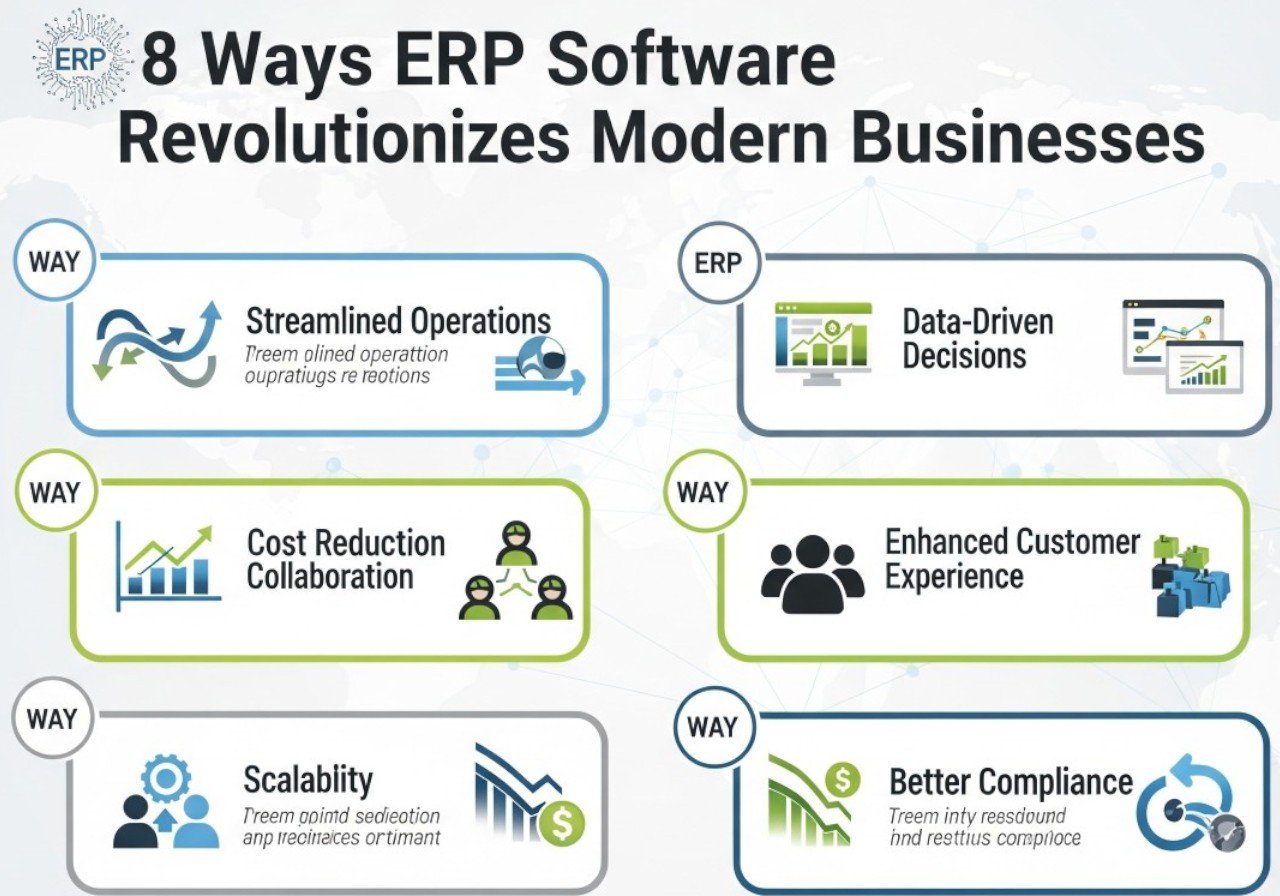
Here’s a unique look at 8 ways ERP software transforms businesses today.
1. Unified Platform for All Operations
1.1 Eliminates Fragmentation
Many businesses struggle with separate software for finance, HR, inventory, and sales. ERP brings everything into one system, ensuring that data flows smoothly between departments.
1.2 Better Internal Communication
A unified platform allows employees to access shared information instantly. For instance, the sales team can check stock availability before confirming orders, reducing delays and mistakes.
1.3 Consistency in Data
Centralized data ensures that everyone sees the same information. This reduces conflicts, confusion, and errors, which are common when multiple systems are used.
2. Automation of Routine Tasks
2.1 Finance Automation
ERP automates invoicing, payroll, and expense tracking. This not only speeds up processing but also reduces human errors and ensures compliance with financial regulations.
2.2 Inventory Automation
Real-time inventory tracking alerts managers about low stock or overstock situations. ERP can even automatically generate purchase orders to maintain optimal inventory levels.
2.3 HR Process Automation
Tasks such as leave approval, attendance tracking, and employee onboarding are automated, saving time for HR teams and improving employee satisfaction.
3. Real-Time Analytics and Insights
3.1 Instant Access to Data
ERP dashboards provide up-to-date information on sales, production, and finance. Managers can see trends and performance metrics in real-time.
3.2 Forecasting Capabilities
Modern ERP systems use AI to predict future sales, inventory needs, or production challenges. Businesses can make proactive decisions instead of reacting to problems later.
3.3 Customized Reports
ERP allows businesses to generate reports tailored to their goals. Whether tracking sales growth or employee performance, reports provide actionable insights.
4. Cost and Resource Optimization
4.1 Reducing Operational Errors
Centralized data and automated workflows reduce mistakes that could lead to financial loss.
4.2 Efficient Use of Resources
ERP helps track resource usage, including staff, materials, and machinery. This ensures that resources are used efficiently, reducing waste and saving costs.
4.3 Time Efficiency
Employees spend less time on repetitive tasks and more time on strategic initiatives, improving overall productivity.
5. Better Customer Relationship Management
5.1 Faster Service
ERP centralizes customer data, allowing teams to respond quickly to inquiries, complaints, or support requests.
5.2 Order Accuracy
ERP ensures that orders are processed correctly, reducing mistakes and improving customer satisfaction.
5.3 Customer Insights
Tracking purchase history, preferences, and feedback helps businesses provide personalized services and improve loyalty.
6. Flexibility and Scalability
6.1 Modular Structure
ERP modules can be implemented as needed. A company can start with core functions like finance and inventory, and add more modules as it grows.
6.2 Support for Remote and Multi-location Teams
Cloud ERP solutions allow teams to access data from anywhere. Multi-location businesses can synchronize operations easily.
6.3 Adaptable to Growth
As the business expands, ERP systems can scale up to manage increased operations without requiring a new system.
7. Compliance and Risk Management
7.1 Simplified Compliance
ERP tracks industry regulations, tax rules, and labor laws automatically, reducing the risk of non-compliance.
7.2 Audit Readiness
Every transaction is logged in ERP, creating an audit trail that simplifies inspections and reporting.
7.3 Proactive Risk Identification
ERP can flag potential issues, such as low inventory or delayed payments, allowing managers to address them before they escalate.
8. Competitive Advantage in the Market
8.1 Streamlined Operations
Efficient, integrated processes allow businesses to operate faster and more reliably than competitors using fragmented systems.
8.2 Data-Driven Strategy
Real-time insights and analytics enable informed decisions that improve performance and growth.
8.3 Focus on Innovation
By automating routine tasks, employees can concentrate on innovation, marketing strategies, and customer experience improvements.
Conclusion
ERP software is no longer just a tool for large enterprises — it is a strategic asset for businesses of all sizes. By integrating processes, automating tasks, and providing actionable insights, ERP allows businesses to operate efficiently, satisfy customers, and stay ahead of competitors.
In 2025, adopting ERP is not just an option; it’s a critical step toward sustainable growth and success.